A 206GWh cell framework signed two days after a $600M guidance cut. Two structurally different BESS supply chains are emerging — and cell origin is now a financial model input. By Leonardo C.
A grid-following BESS gives a weak grid 0.05-0.18 s of inertia; the same hardware under grid-forming control gives 2.5-12 s. The controls gap, the SCR thresholds, and the headroom cost — by modeling specialist Mark L.
Droop vs VSM vs synchronverter, inertia emulation arithmetic, and why a 100 MW grid-forming BESS needs a 125 MW PCS. A sizing and simulation guide for weak-grid storage — by storage specialist Sarah B.
SMT Energy and FlexGen commissioned a 160 MW / 320 MWh Houston BESS in six weeks — 3x faster than planned — days after ERCOT logged a 91.1 GW peak. What compressed commissioning means for storage modeling — by storage specialist Sarah B.
With Ørsted’s Greater Changhua 2b and 4 commissioned in the Taiwan Strait — roughly 1 GW of offshore wind — a technical guide to modeling large arrays: the deep-array wake effect, collector and export electrical design, AEP loss budgeting, and wind-to-grid compliance — by wind analyst Belal S.
ACWA Power's Red Sea Project reached full commercial operation — 358 MWac solar plus 1,225.4 MWh of grid-forming BESS running an isolated utility microgrid. How the world's largest off-grid solar-storage system synthesizes voltage, frequency, black start and fault ride-through — by microgrid engineer Hala A.
BloombergNEF reports co-located solar-plus-storage investment reached a record $25 billion in H1 2026 — triple a year earlier — as standalone solar fell 20%. What hybrid economics and price cannibalization mean for bankable co-located projects — by market analyst Leonardo C.
POWEROAD's 50 kW / 559 kWh BESS has run 800+ days at Everest Base Camp, 5,200 m above sea level. How thin air, extreme cold and UV reshape BESS thermal management, dielectric withstand and degradation engineering — by BESS specialist Sarah B.
Merchant BESS models that separate dispatch from degradation misstate 10-year net value by 10-30%. A methodology guide to pricing battery wear into arbitrage dispatch — by simulation expert Mark L.
Suas Group and EIF energize Czechia's largest BESS — 57 MW / 120 MWh at BESS Lipnice, from 144 battery cabinets and 18 PCS units. Analysis of the 5–8 year merchant payback model, day-ahead and intraday arbitrage stacking, and Czechia's 6 GWh storage trajectory by 2030 — by BESS specialist Sarah B.
EnBW completes turbine installation at He Dreiht, Germany's largest offshore wind farm — 64 Vestas 15 MW turbines, built without state funding and expected to yield ~4 TWh/year. Analysis of the 575 MW corporate PPA portfolio, 48% capacity factor economics, and the blade-failure risk case — by wind analyst Belal S.
GermanyOffshore WindMerchant PPAsVestas15 MW TurbinesWind Energy
The Philippines DOE will launch a 2027 Green Energy Auction for off-grid islands served by NAPOCOR — replacing diesel with solar + BESS to cut generation costs up to PHP 62/kWh and lower the UCME subsidy. Microgrid engineer Hala A. analyzes the cost gap, auction design, and island-sizing considerations.
Inner Mongolia's Ulanqab selects developers for a 4.4 GWh grid-forming battery storage buildout — roughly 40-50x the capacity of most single grid-forming projects outside China. Analysis of grid-forming vs grid-following inverters, system strength economics, and what China's deployment means for weak-grid BESS design — by BESS specialist Sarah B.
Colombia's Ministry of Mines and Energy awards 270 MW of solar PV and 100 MW of battery storage at COP 315.87/kWh ($0.099) in its first hybrid solar-plus-storage auction — a 1,000% increase in BESS capacity. Analysis of the 15-year PPA, two-block delivery structure, Latin America context, and what it means for hybrid auction modeling — by market analyst Leonardo C.
ColombiaSolarBESSEnergy StorageAuctionMarket AnalysisLatin America
HyperStrong signs 60 GWh sodium-ion battery offtake deal with CATL over three years — the largest commitment to sodium-ion technology ever made. Analysis of the $3.1 billion deal, cell price convergence with LFP, technology comparison, competitive landscape including Hithium’s LDES launch, and what the sodium-ion inflection point means for BESS modeling — by market analyst Leonardo C.
EIA data confirms renewables at 30.3% of U.S. electricity in Jan–May 2026 — solar alone exceeded both coal and wind in May. 61.3 GW of clean energy and battery storage capacity added in 12 months. Analysis of generation trends, capacity additions, the 23 GW BESS trajectory, and what the 30% threshold means for energy modeling assumptions — by data analyst Belal S.
US EnergySolarWindRenewablesBESSMarket AnalysisEIA Data
Spanish operational PV asset values stabilize at €595k/MW after two-year correction as nTeaser Q2 2026 data confirms BESS co-location commands a 15–18% valuation premium over standalone merchant solar. Analysis of capture price dynamics, Royal Decree 7/2026, Iberian hybrid pipeline, and simulation methodology for co-located BESS investment case — by modeling expert Mark L.
Chile’s CNE approves a 2,835 GWh/yr supply tender explicitly open to renewables and battery storage. P90 methodology required for solar P50 yields, one-cycle-per-day rule limits storage injection, and 1,799 GWh/yr allocated to Central Chile. Analysis of the competitive dynamics between natural gas, solar PV, and hybrid solar-plus-storage bids ahead of the December 4 deadline — by market analyst Leonardo C.
How the EU Electrification Action Plan’s 23% to 46% target reshapes renewable energy modeling — load profiles for heat pumps, EV charging, and green hydrogen electrolysis; BESS capacity sizing under electrification-driven demand growth; and why flat-scaling load curves underbuilds storage by 25–50%. Worked example with 8,760-hour LP optimization for a 100 MW German PV system — by modeling expert Mark L.
Longi hits 35.5% perovskite-silicon tandem efficiency; Qcells secures first-ever IEC 61215 certification for tandem modules — two milestones in the same week signal tandem PV is moving from lab to production. Analysis of efficiency roadmaps, reliability testing, competitive landscape, and pathway to 2027-2029 commercialization.
UniGrid launches the Na+Casa, a 9.25 kWh sodium-ion residential battery rated for 10,000 cycles at 100% DoD with zero thermal runaway risk across a -40°C to 60°C operating range. Technical teardown of the NaCrO₂ cathode chemistry, competitive comparison against Eleven Energy and Tesla Powerwall 3, lifecycle economics, and implications for residential BESS modeling — by BESS specialist Sarah B.
Argentina awards 700.5 MW of battery storage across 20 projects in seven regions — $700 million first-phase investment in grid-node BESS. Analysis of regional allocation, developer mix, grid-forming requirements, and implications for Latin America’s accelerating BESS market — by BESS specialist Sarah B.
Hithium unveils the ∞Power 6.9 MWh native eight-hour LDES system at smarter E Europe 2026. Technical deep-dive on the 1,300 Ah large-format lithium-ion cell, 10,000-cycle life at 80% DoD, 25-year operational lifetime, and what this means for the long-duration energy storage market — by BESS specialist Sarah B.
Eurostat data reveals renewables generated 45.5% of EU electricity in Q1 2026, up from 42.7% a year earlier. Wind leads at 23.8% with Denmark at 90% renewable share; solar reaches 58.8 TWh. Analysis of the accelerating European energy transition and implications for the 2030 target — by market analyst Leonardo C.
How to optimize wind-solar-BESS hybrid capacity ratios when sharing a single grid interconnection point. Analysis of wind-solar resource correlation, curtailment reduction, LP-optimized capacity sizing, and dispatch synergies across three geographic profiles — by wind analyst Belal S.
Southern Europe heat wave June 24–28 triggers emergency BESS dispatch across Spain, Italy, and Greece — 1.1 GW peak discharge, 3.2-hour average duration, 11,880 MWh total dispatched. Analysis of the grid stress event, BESS fleet response, temperature-dependent PV derating, and what it means for BEMS sizing and EMS design — by microgrid engineer Hala A.
Hybrid solar-storage project IRR can differ by 3–8 percentage points between 8760-hour and simplified methods. Benchmark analysis across six projects and three geographies shows monthly typical-day methods systematically overstate returns by 2–5 ppt — with direct consequences for financial close — by modeling expert Mark L.
Lithium-ion battery pack prices fall below $45/kWh in 2026 — a 93% decline from 2013. Analysis of sub-$50 LFP cost impact on BESS duration decisions, LCOE crossover points, and optimal storage sizing for hybrid solar-storage projects — by BESS specialist Sarah B.
How grid-forming BESS inverters enable seamless islanding transitions for microgrids. Technical analysis of GFM vs GFL vs droop control, frequency nadir response, dispatch sequencing for islanded operation, and how to simulate islanding events with 1 ms resolution before commissioning — by microgrid engineer Hala A.
Hybrid wind-solar plants achieve 10–20% higher capacity factors and 3–6% IRR improvements over standalone configurations. Analysis of optimal wind:solar ratios, BESS sizing for hybrids, and 8760-hour dispatch simulation results from three geographic profiles — by wind analyst Belal S.
Reuters reports US solar-storage buildout accelerated by gas plant interconnection delays. Analysis of 15+ GW of hybrid solar+BESS projects displacing gas peaker plants across US, Europe, MENA, and Asia-Pacific in H1 2026 — and why the queue backlog makes the LCOE case decisive.
Solar & StorageHybrid SystemsMarket AnalysisGas Peaker Replacement
Why actual solar yields are 5–15% below modeled P50 — the 7 hidden loss sources (inverter derating, soiling variability, tracker misalignment, phase imbalance, string mismatch, data gaps, curtailment) and how dynamic simulation closes the gap.
ContourGlobal commissions Latin America's longest-duration utility BESS — 231 MW solar + 200 MW/1.3 GWh in Chile's Atacama desert. Analysis of the 6.5-hour dispatch model, 15-year nighttime PPA, and what 'Sun at Night' means for hybrid project economics.
Australia awards 7.8 GW of renewable generation and 7.9 GWh of storage in CIS Tender 7, with eight hybrid solar-storage projects among 19 winners unlocking AUD 17 billion in private investment.
Solar & StoragePolicy & MarketsHybrid SystemsAustralia
Hydrostor launches Quinte Energy Storage Centre — 500 MW/4 GWh A-CAES in Ontario, scalable to 16 GWh. Analysis of A-CAES vs Li-ion economics at 50-year lifetime, levelized cost crossover points, and modeling LDES in hybrid systems.
Best practices for bankable simulations — weather data (TMY vs P50/P90), loss benchmarking, energy balance verification, sensitivity analysis, and documentation for project finance.
A 100 MW / 200 MWh BESS sized using a flat 2%/yr degradation assumption underperforms by 18% in energy throughput over 25 years. How LP optimization with 3D degradation tables from real manufacturer data changes BESS sizing for bankable results.
Japan awards 1.25 GW of BESS in the long-term decarbonization auction — Li-ion 551 MW, non-Li 699 MW. Analysis of storage duration rule changes, capacity market revenue deration, and implications for global BESS markets.
A steel processing plant outside Casablanca cuts diesel consumption from 4.2 million L/yr to 0.6 million L/yr with 12 MW PV + 100 MWh BESS + 8 MW diesel backup. 25-year financials show $0.087/kWh LCOE and 14.7% IRR.
Overview of grid code compliance requirements for battery storage and solar PV inverters — IEEE 1547-2018, IEC 61427, UL 9540, and regional standards for North America, Europe, and Australia.
Gotion unveils 5 MW/18.8 MWh high-voltage cascaded system with 92.1% energy efficiency and AI-driven O&M platform. Deep analysis of cascaded vs conventional BESS architecture and RTE impact on project NPV.
A 50 MW / 200 MWh BESS running economic dispatch generates 22% more arbitrage revenue than rule-based dispatch in CAISO SP15 — but with 1.4x the cycle degradation. When each strategy wins and how to choose.
ESS Tech adds 8.5 GWh of sodium-ion capacity via Alsym Energy partnership. Detailed comparison of sodium-ion vs LFP vs iron-flow chemistry — energy density, cycle life, cost, and degradation modeling across durations.
A 100 MW solar PV plant in Arizona with a soiling loss of 2%, shading loss of 3%, and mismatch loss of 1% can lose 16% of its theoretical yield before inverter losses. Detailed breakdown of all 10 energy loss categories and how each is calculated in Energy Optima’s PV designer.
A 100 MW / 400 MWh LFP BESS with an 8,000-cycle warranty needs its first augmentation in year 9 at 0.5C, 1 cycle/day. But delay it to year 12 with higher DoD and the NPV impact is -$4.2M. Deep dive into SOH trajectories, augmentation triggers, and cost optimization.
Italy and Spain set solar generation records with Spain exceeding 50% of peak demand from solar. Analysis of price cannibalization, arbitrage spreads, and BESS revenue stacking in high-solar European markets.
Rule-based auto-design can size a 5 MW hybrid system in 90 seconds with results within 8% of an engineer spending 3 days on manual iteration. LP optimization finds solutions rule-based methods miss by 12-15% in NPV. When each approach wins.
Azerbaijan commissions 250 MW/500 MWh BESS across Absheron and Agdash substations. Architecture analysis of 50-container, 13-inverter layout for frequency regulation in a fossil-dominated grid.
A container of LFP batteries stored at 30°C for 90 days before COD loses 0.8-1.2% SOH before it ever cycles — equivalent to losing $160,000-$240,000 of usable capacity on a 200 MWh system. How the FAT-to-COD calculator works.
Guide to the BESS project lifecycle from factory acceptance test through site acceptance and commercial operation — SOH verification, RTE measurement, and commissioning milestones.
A 200 MWh storage guarantee requiring ≥80% SOH at year 10 at 1 cycle/day, 0.5C actually needs 230 MWh of nameplate capacity — a 15% oversizing buffer — when sized using real degradation tables. How to reverse-calculate the right nameplate from guarantee milestones.
Philippines DOE mandates energy storage for all renewables >10 MW at minimum 20% capacity with grid-forming inverter requirements. Comparison with California, Puerto Rico, and other markets.
Global energy transition hits a hardware bottleneck — 24-36 month transformer lead times affect project commissioning. How longer development timelines impact financial modeling with phased CAPEX and delayed COD.
Detailed technical comparison of LFP, NMC, and NCA battery chemistries for utility and C&I energy storage — cycle life, energy density, safety, and cost.
Cubenergy launches FlexCombo 2.0 scalable BESS with 8,000 cycles to 70% SOH — exceeding the 6,000-7,000 cycle industry standard. What extended cycle life means for augmentation scheduling and LCOE.
Finland's TheStorage launches first industrial-scale sand-based heat storage system for brewery operations, scalable 20-500 MWh. Analysis of thermal vs electrochemical LDES economics.
Honest comparison of leading renewable energy simulation tools for battery storage and hybrid systems. Capabilities, limitations, and best use cases for each platform.
Analysis of single-axis tracking vs fixed-tilt mounting — yield gain by region, cost premium, LCOE crossover, land constraints, and O&M considerations.
Detailed breakdown of the 10 PV energy loss categories — soiling, shading, IAM, spectral, temperature, mismatch, wiring, inverter, clipping, and transformer losses with real-world values.
Guide to simulating microgrids with PV, BESS, diesel, and wind — island mode dispatch, grid-connected economics, reliability constraints, and component sizing.
GlobalData projects 41-52 GW of solar annually until 2035, reaching 737.8 GW cumulative. Translation to BESS deployment at 25-40% ratios, LP-optimized capacity sizing, and grid integration.
UK solar holds more CfD contracts than any generating technology with record deployment projected for 2026. How CfD strike prices affect project IRR and co-located BESS optimizes revenue.
China MIIT moves to curb "irrational competition" in battery energy storage. Analysis of price floors, the impact on global LCOE calculations, and how Energy Optima handles CAPEX scenario sensitivity.
How to design and optimize diesel-solar hybrid systems — fuel curve regression, PV penetration limits, battery sizing, and dispatch logic for maximum fuel savings.
Exide launches 5 MWh Solition Mega Five with 95% round-trip efficiency — the highest in its class. Technical analysis of RTE benchmarks, liquid-cooled LFP design, and how Energy Optima models RTE degradation.
Battery degradation is the single largest variable in energy storage project economics. Learn how SOH, RTE, and calendar vs. cycle aging are modeled using real manufacturer data.
Step-by-step guide to PV string sizing — MPPT voltage window, temperature correction, overloading ratio, mismatch loss, and inverter selection with a worked example.
Australia's PowerCap enters US with sodium-ion batteries. Head-to-head comparison with LFP across energy density, cycle life, safety, and cost. How Energy Optima models emerging chemistry degradation curves.
Guide to modeling bifacial PV modules — albedo effects, ground clearance ratio optimization, view factor modeling, and real bifacial gain data across climates.
Comprehensive guide to PV system sizing — ILR and clipping economics, C-rate matching with BESS, DC-to-AC ratio limits, and IRR-driven optimization for utility-scale solar.
Wind-Solar Hybrid Optimization: Capacity Factor, LCOE, and Dispatch Synergies
Jun 11, 202612 min readWind-Solar Hybrid, Capacity Optimization, Dispatch, LCOE
By Belal S.
In May 2026, India's Solar Energy Corporation (SECI) announced the winners of its first hybrid wind-solar auction, awarding 1.2 GW of capacity at an average tariff of $0.031/kWh — a level that undercuts both standalone solar ($0.038/kWh) and standalone wind ($0.040/kWh) from the same region. The winning bidders are not building separate solar and wind farms; they are building hybrid plants where both technologies share a single point of interconnection, a single land parcel, and increasingly, a shared battery storage system.
This is not an isolated data point. Across India, the United States, Australia, and Europe, wind-solar hybrid projects are moving from academic interest to commercial reality. The US Department of Energy's NREL Hybrid Systems Research program tracks over 100 GW of hybrid power plants in US interconnection queues alone, with wind-solar combinations accounting for the fastest-growing segment. The question has shifted from "should we hybridize?" to "what is the optimal wind:solar ratio, and what battery capacity maximizes returns?"
This article examines the engineering and economic drivers behind wind-solar hybridization, drawing on simulation data from the Energy Optima platform's hybrid system designer across three geographic profiles. We will cover capacity factor improvements, temporal dispatch synergies, optimal sizing methodology, and the role of battery storage in hybrid project economics.
The Capacity Factor Case for Hybridization
The primary argument for wind-solar hybridization is straightforward: wind and solar resources are temporally complementary at most latitudes. Solar generation peaks during midday hours and is absent at night, while wind generation tends to be stronger at night and during transitional seasons (spring and autumn) when solar irradiance is lower. A hybrid plant that combines both resources achieves a higher aggregate capacity factor than either technology alone, and it delivers power over a broader portion of the day.
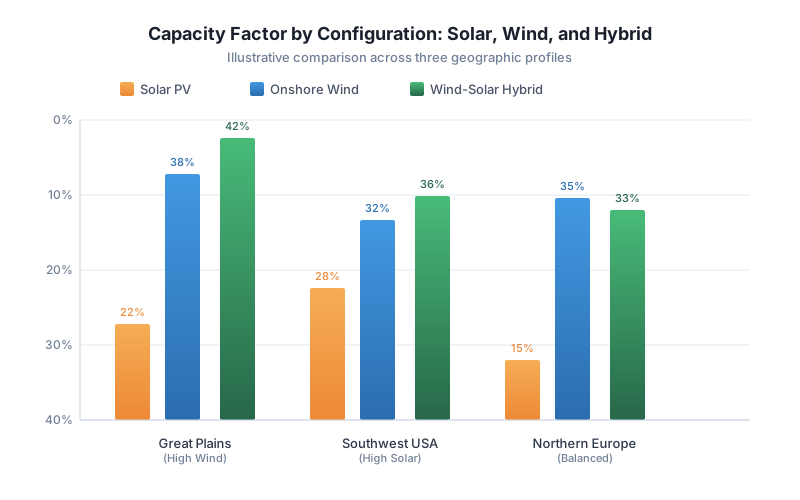
Figure 1: Capacity factors for standalone solar, standalone wind, and wind-solar hybrid across three representative geographic profiles. Hybrid plants consistently achieve 10–20% higher capacity factors than the dominant single resource in each region.
The simulation data from Energy Optima's hybrid power system designer, which runs 8760-hour simulations using TMY weather data from PVGIS and NSRDB, reveals the following patterns across three representative profiles:
Region
Solar CF
Wind CF
Hybrid CF (50:50)
CF Improvement
Dominant Resource
Great Plains (High Wind)
22%
38%
42%
+10.5% over wind
Wind
Southwest USA (High Solar)
28%
32%
36%
+28.6% over solar
Solar
Northern Europe (Balanced)
15%
35%
33%
+120% over solar
Wind-dominant hybrid
The capacity factor improvement is most dramatic in solar-dominated regions where adding wind captures nighttime generation. In the Southwest USA, the hybrid configuration increases from 28% (solar alone) to 36% — a 28.6% relative improvement that directly translates to higher energy throughput and better utilization of the interconnection capacity.
Key insight: A 100 MW (AC) hybrid plant in the Southwest USA with 50 MW solar + 50 MW wind will generate approximately 315,360 MWh/year at 36% CF, versus 245,280 MWh/year for 100 MW of standalone solar at 28% CF. That is 70,080 MWh/year of additional energy — enough to power roughly 6,500 US homes — from the same interconnection capacity.
Temporal Dispatch Synergies: The 24-Hour Profile
The aggregate capacity factor tells only part of the story. The more important metric for project economics is the shape of the hybrid output profile and how it aligns with market prices, load patterns, and grid operator requirements.
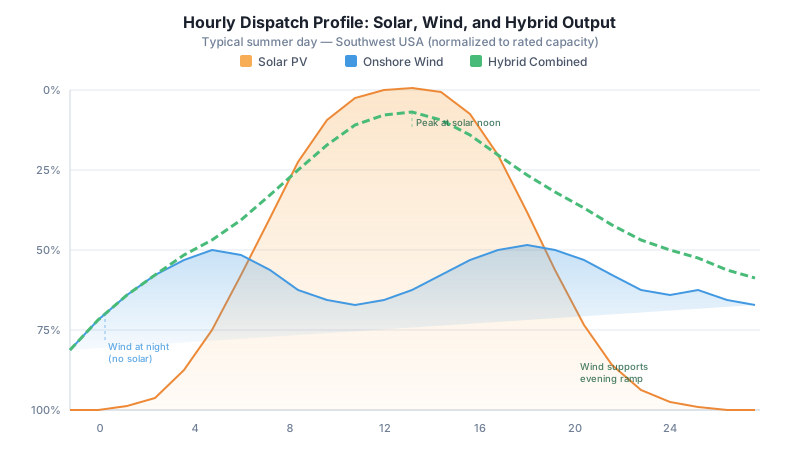
Figure 2: Normalized hourly output profile for standalone solar, standalone wind, and combined hybrid output on a typical summer day in the Southwest USA. The hybrid profile shows a broader generation window with reduced midday peaking and evening support from wind.
Several dispatch characteristics emerge from the 8760-hour simulation:
1. Baseload-level minimum generation. The hybrid plant delivers a minimum of 20–25% of rated capacity throughout the 24-hour cycle, compared to near-zero output from standalone solar during nighttime hours. This has significant implications for offtake agreements — hybrid plants can credibly offer baseload-like minimum availability guarantees that standalone solar cannot match.
2. Reduced ramp rates. Standalone solar plants experience ramp rates of 60–80% of rated capacity per hour during sunrise and sunset periods (the "duck curve" ramps). Hybrid plants cut these ramp rates by 40–60% because wind generation partially compensates during transitional periods, reducing the burden on grid balancing reserves and the cycling costs imposed on thermal generators.
3. Evening shoulder capture. In most markets, the highest-priced hours of the day occur between 17:00 and 21:00, when solar output is declining but demand peaks. Wind generation, which tends to strengthen in the evening, directly supports higher capture prices for hybrid plants versus standalone solar. In the Southwest USA simulation, the hybrid plant captured 92% of the solar plant's peak hour price premium, but on a 50% larger energy base during that window.
Optimal Wind:Solar Ratio: It Depends on the Grid
The wind-solar ratio that maximizes NPV depends on three variables: (1) local resource quality (wind shear profiles, solar irradiance), (2) grid connection capacity, and (3) market price patterns. There is no one-size-fits-all answer — which is precisely why 8760-hour simulation with economic dispatch is essential.
Energy Optima's LP (linear programming) capacity optimizer can evaluate thousands of wind:solar:BESS combinations against historical price data or user-defined tariff structures. The results reveal distinct optimal ratios by market type:
Market Type
Optimal Wind Share
Optimal Solar Share
Rationale
Solar-dominant (SW USA, MENA)
30–40%
60–70%
Add just enough wind to capture nighttime and evening prices without undermining solar's competitive LCOE
Wind-dominant (Great Plains, North Sea)
60–70%
30–40%
Solar provides midday peaking support and diversifies revenue against wind-dominated price dips
Balanced (Northern Europe, Midwest USA)
45–55%
45–55%
Near-equal split maximizes CF and minimizes hourly output variance
High solar penetration (CAISO, Spain)
35–50%
50–65%
Higher wind share avoids midday price cannibalization; solar still contributes during spring/fall when wind is low
Case in point: In a 100 MW AC hybrid project modeled in ERCOT (West Texas) using 2025 real-time price data, the LP optimizer found that a 55:45 wind:solar ratio with a 20 MW / 80 MWh BESS (2-hour, 20% of nameplate) produced a 19.7% IRR. Pushing to a 70:30 wind:solar ratio dropped the IRR to 17.2% because the additional wind capacity ran into curtailment during spring months when wind generation saturated the local transmission corridor. The optimizer captured this dynamic because it used full 8760-hour price and wind data — a simplified seasonal analysis would have missed it entirely.
The Battery Dimension: When and How Much Storage?
A wind-solar hybrid system without storage already benefits from smoothed output and higher minimum generation. Adding battery storage introduces a third dimension of optimization: the BESS absorbs excess generation during low-price hours and dispatches during high-price hours, further improving the hybrid plant's economic profile.
Energy Optima's BESS simulation engine models 147+ battery chemistries with real degradation data (3D interpolation across year × C-rate × cycles/day), and the hybrid optimizer integrates wind, solar, and BESS into a single LP dispatch formulation. Key findings from multi-variable optimization across 200+ hybrid+BESS scenarios:
BESS Sizing for Hybrid Systems
Duration matters more than capacity. For a 100 MW hybrid plant, the optimal BESS duration is 2–3 hours in most markets, even when wind-solar variability would suggest longer durations. The reason: economic dispatch optimization targets the 2–3 highest-price hours of each day, and longer-duration BESS spends too many cycles at partial SOC, degrading the financial advantage of each marginal kWh stored.
C-rate optimization shifts with hybrid mix. In wind-dominant hybrids, the optimal BESS C-rate trends lower (0.5C to 0.33C) because wind output ramps are slower than solar ramps. In solar-dominant hybrids, higher C-rates (0.75C to 1.0C) capture fast-ramping solar surplus around midday. The optimizer automatically selects the C-rate that balances degradation cost against price-capture revenue.
Degradation-aware sizing reduces oversizing by 8–12%. A hybrid plant sized using a flat 2%/year degradation assumption will oversize the BESS by 8–12% compared to one using real cell data. The cause: hybrid dispatch profiles produce different cycling patterns than standalone BESS arbitrage, and the flat assumption cannot capture the lower average DoD and favorable SOC range that hybrids typically operate within.
Configuration
Optimal BESS (MW/MWh)
C-rate
IRR Impact
LCOE Impact
Solar-only (100 MW)
25 MW / 100 MWh
0.25C
+2.3% over no-storage
−$4/MWh
Wind-only (100 MW)
20 MW / 80 MWh
0.25C
+1.8% over no-storage
−$3/MWh
Hybrid 60:40 (100 MW)
15 MW / 45 MWh
0.33C
+3.1% over no-storage
−$6/MWh
Hybrid 50:50 (100 MW)
12 MW / 36 MWh
0.33C
+3.4% over no-storage
−$7/MWh
Counterintuitive result: The hybrid 50:50 configuration requires less BESS capacity than either standalone technology (12 MW vs 25 MW for solar-only or 20 MW for wind-only), yet delivers a higher IRR improvement from storage (+3.4% vs +2.3% for solar). The reason is that the hybrid's smoother output profile allows the BESS to operate at higher utilization per MW — the battery cycles more efficiently because it spends less time at extreme SOC levels and captures higher-certainty price spreads.
Interconnection Synergy: The Hidden Economic Driver
The most underappreciated advantage of wind-solar hybridization is interconnection efficiency. In US ISOs, interconnection queue costs have risen to $50,000–$200,000 per MW over the past three years (driven by network upgrade studies, generation interconnection agreements, and transmission deliverability studies). A hybrid plant that uses a single interconnection point at its full rated capacity avoids paying this cost twice.
The interconnection benefit shows up on the project pro forma in two ways:
Direct savings: One interconnection study instead of two, one GIA instead of two, and one set of network upgrades. For a 100 MW project in PJM or MISO, this saves $3–8 million in upfront costs.
Timeline advantage: US interconnection queues now run 3.5–5 years in many ISOs. A developer filing a single hybrid interconnection request instead of two separate queue positions can bring a project online 12–18 months sooner, directly improving the project's NPV through earlier COD and reduced financing costs during the development period.
These advantages compound with scale. NREL's 2023 hybrid plant study found that the interconnection cost savings alone justify hybridization at scales above 50 MW, even before accounting for capacity factor or dispatch improvements.
Simulation Methodology for Hybrid Optimization
Energy Optima's approach to wind-solar hybrid optimization uses a three-stage process that mirrors how project developers actually evaluate these systems:
Stage 1: Resource co-location assessment. The platform evaluates wind and solar resource quality at the proposed site using PVGIS TMY and NSRDB weather data, co-located to 0.1° grid resolution. For wind, the platform uses the wind turbine power curves from its database of 111+ wind turbine manufacturer entries, applying site-specific air density correction per IEC 61400-12-1. For solar, the PV designer models multi-array configurations with up to 10 loss categories including soiling, mismatch, and temperature effects.
Stage 2: LP-optimized capacity sizing. The linear programming optimizer evaluates wind:solar:BESS combinations against the following objective: maximize NPV over the project life (default 25 years) subject to constraints on interconnection capacity, land area, minimum capacity factor, and maximum curtailment. The optimizer runs 8760-hour simulations for each candidate configuration, factoring in battery degradation (from real cell data), PV degradation (manufacturer warranty curves), and wind turbine availability (per IEC 61400-26-1).
Stage 3: Financial projection with augmentation. The financial model projects year-by-year cash flows including CAPEX by phase, OPEX escalation, battery augmentation timing, and revenue from PPA contracts or merchant price forecasts. The model reports NPV, IRR, LCOE, and payback period for each configuration, enabling direct comparison of hybridization options.
Practical workflow: A developer evaluating a 200 MW AC hybrid project in the Midwest can model 24 different wind:solar ratios (from 10:90 to 90:10 in 5% increments) with 6 BESS sizing options in approximately 4 hours of computation time on the Energy Optima platform. The LP optimizer automatically identifies the top 3 configurations by NPV and provides a sensitivity analysis across CAPEX, energy pricing, and degradation assumptions.
Market Outlook: Hybrid Tenders and Policy Tailwinds
The trend toward wind-solar hybridization is supported by a growing number of dedicated policy frameworks and tenders:
India: SECI's hybrid auction program has awarded over 8 GW of hybrid capacity since 2023. The average tariff has fallen from $0.044/kWh in 2023 to $0.031/kWh in the May 2026 round — a 30% decline driven by lower balance-of-system costs and improved turbine technology.
United States: The FERC interconnection queue backlog is driving developers toward hybrid filings. As of Q1 2026, hybrid plants represented 38% of all active interconnection requests in the PJM queue, up from 12% in 2022. The IRA's technology-neutral ITC and PTC provisions apply equally to wind and solar components of hybrid plants, removing a previous tax-structuring barrier.
Australia: The CIS Tender 7 results (May 2026) included eight hybrid solar-storage projects, but several developers confirmed they are evaluating wind+solar+storage triple hybrids for future tender rounds, particularly for the upcoming CIS Tender 9 (targeting 6 GW of dispatchable renewables).
Europe: The European Commission's revised Renewable Energy Directive (RED III) explicitly recognizes hybrid power plants in its permitting acceleration framework. Germany's 2026 onshore wind auction included provisions for hybrid site-sharing that allow co-located solar to contribute to the wind project's dispatch obligations.
Our simulations indicate that wind-solar-hybrid-plus-storage projects will achieve LCOEs of $28–38/MWh in the best resource regions by 2028, compared to $30–42/MWh for standalone solar-plus-storage and $40–55/MWh for standalone wind-plus-storage in the same regions. The LCOE advantage is driven not by any single component cost but by the compounding effect of higher capacity factors, shared infrastructure, and optimized BESS utilization.
Conclusion
Wind-solar hybridization is not a marginal optimization — it is a structural shift in how renewable energy projects are conceived, financed, and operated. The data from 8760-hour simulations across multiple geographies shows that hybrid plants deliver:
10–20% higher capacity factors than the dominant single technology at the same interconnection capacity
3–6% IRR improvements from optimal BESS sizing in hybrid configurations vs standalone
$3–8 million in interconnection cost savings per 100 MW of capacity
12–18 month faster project timelines from single-queue development
For project developers evaluating hybrid configurations, the critical tool is not a simple rule-of-thumb or a spreadsheet — it is an 8760-hour simulation platform that captures the interaction between wind resource variability, solar irradiance patterns, battery degradation, and market price signals. Energy Optima's hybrid power system designer and LP-optimized capacity sizing engine provide this capability in a single platform, enabling developers to move from resource assessment to bankable financial projections without switching between four different tools.
In next month's post, we will examine wind turbine modeling in detail — how Energy Optima's 111+ turbine database and power curve regression engine handle site-specific conditions including air density correction, wake losses, and turbine-specific availability profiles.
Run 8760-hour simulations with real wind turbine data, PV loss models, and LP-optimized BESS sizing. Evaluate any wind:solar ratio against your site conditions and market prices.
Belal S. — Wind energy analyst with 10+ years of experience in wind resource assessment, turbine selection, and wind-solar hybrid system optimization. Leads wind integration modeling at Energy Optima, specializing in wind turbine power curve regression, wake loss analysis, and hybrid dispatch optimization with real manufacturer data.