Renewable Energy Simulation & Optimization Platform
Professional energy modeling for solar PV, battery storage, and hybrid power systems. Simulate 25+ year project economics with bankable accuracy — in minutes.
Why Energy Optima
Complete system integration
Solar PV, wind, diesel, grid services, and TOU optimization. Model the complete energy ecosystem in a single platform—from generation to storage to grid interaction.
Battery storage expertise
Manufacturer-specific degradation tables, chemistry-dependent cycle limits, and multi-year SOH tracking.
Built for your workflow
From feasibility studies to 30-year financial projections — solo engineers to multi-user teams.
Proven & production-ready
Battery simulation, solar modeling, NPV/IRR/LCOE, AI-assisted analysis, and multi-year projections — built by energy engineers for bankable project analysis.
Export-ready reports
Word, Excel, PDF, PowerPoint, and CSV exports. Generate audience-specific reports for engineers, investors, or owners — with your branding.
Simple pricing that scales with you
Free plan for exploration. Paid plans from $99/month with 14-day free trial.
View Pricing Plans →Manufacturer-specific degradation modeling
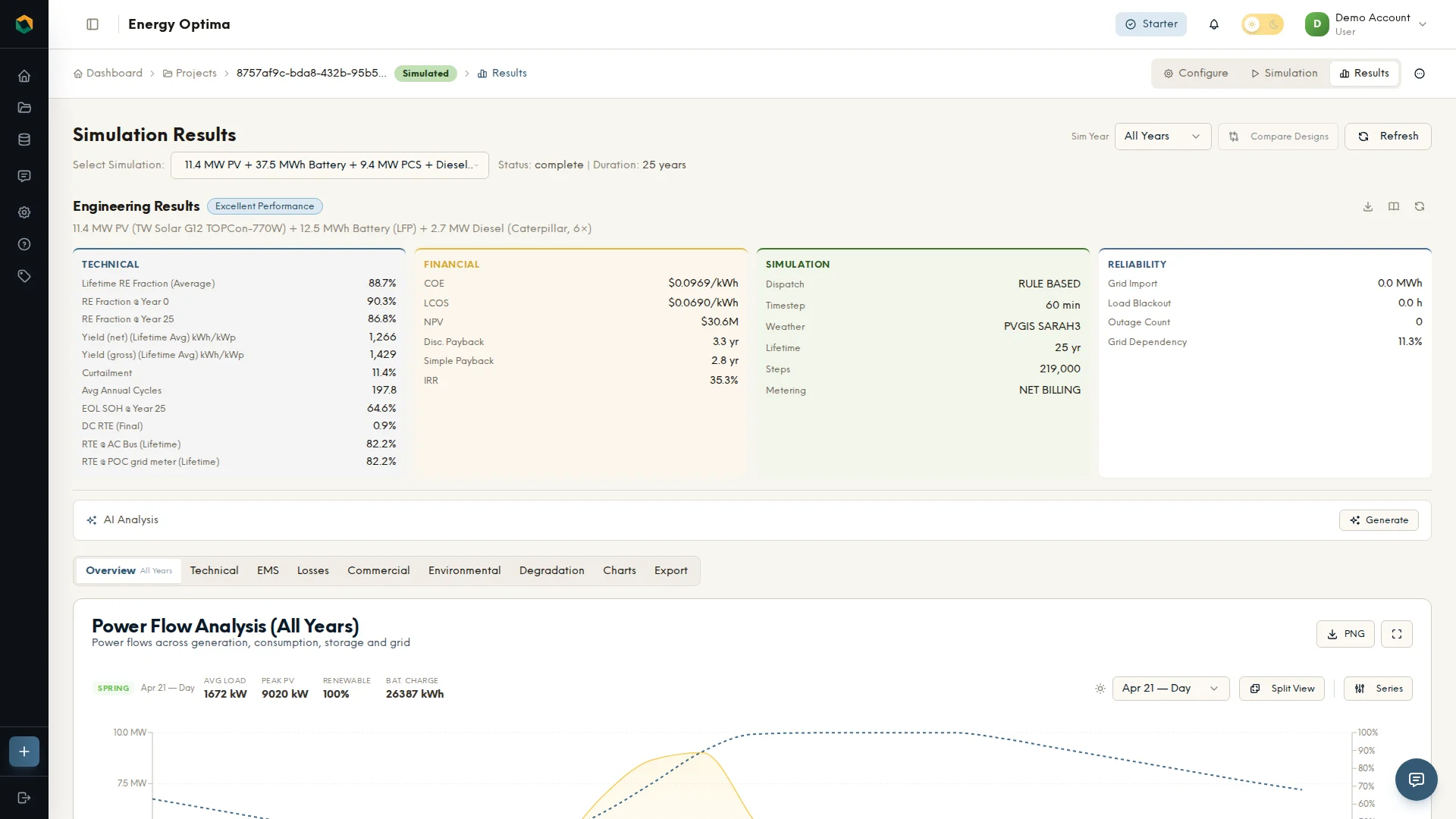
Model battery state-of-health (SOH) and round-trip efficiency losses over 25+ years using real manufacturer degradation tables. Chemistry-specific cycle tracking, auxiliary power consumption, and economic analysis from day one to end-of-life.
- Real battery models from leading manufacturers (CATL, BYD, Samsung SDI, EVE Energy, LG, and more)
- SOC/SOH tracking with 3D degradation interpolation
- Battery augmentation planning with degradation projections
- FAT-to-COD pre-commissioning SOH loss modeling
- Auxiliary power modeling (C-rate × temperature)
Physics-based generation modeling
Calculate solar generation with temperature-corrected PV models, real weather data from PVGIS, and comprehensive loss accounting. Comprehensive module and inverter libraries, hourly simulation for accurate yield predictions.
- PVWatts modeling with NOCT temperature correction
- 10 loss types (soiling, shading, cables, inverter, etc.)
- Multi-array PV Designer with per-array MPPT distribution
- PVGIS weather integration (1994-2022 historical data)
- Capacity factor, specific yield, performance ratio outputs
Bankable economics for project financing
NPV, IRR, LCOE, and payback calculations using NREL methodologies. Multi-year cash flow projections, component-level cost tracking, and sensitivity to key parameters. Financial analysis suitable for investor presentations and lender reviews.
- NPV with configurable discount rates
- IRR via Newton-Raphson convergence
- LCOE with capital recovery factor (CRF)
- Multi-currency support (39 currencies)
- Up to +30 years cash flow analysis


Complete system integration
Model grid interactions with time-of-use tariffs, demand charges, and export policies. Integrate multiple renewable sources (solar PV, wind, diesel) with battery storage for hybrid energy systems. Grid reliability modeling with SAIDI/SAIFI outage simulation and automatic islanded detection.
- TOU tariffs with demand charge optimization
- Wind turbine modeling with configurable wake loss
- Built-in load templates or custom CSV upload
- Grid outage simulation and islanded detection
- Interactive loss waterfall charts and energy flow diagrams
- 2 dispatch strategies: Rule-Based, Economic LP
AI-powered capacity optimization
Define your energy requirements and the optimizer designs the optimal system. Quick Design mode asks minimal questions and produces results in seconds. Full auto-design uses Linear Programming (LP) to minimize LCOE while meeting renewable targets.
- Quick Design: minimal inputs, results in seconds
- LP optimizer: minimum-cost PV + Battery + Wind sizing
- 5 backup strategies for constrained projects
- Outputs: LCOE, IRR, Payback, Renewable Fraction
Real-time dispatch optimization
Go beyond static simulation with Model Predictive Control. The MPC controller continuously re-optimizes dispatch decisions using actual system state — battery SOC, degradation, and real generation data. Adaptive horizons expand or contract based on forecast confidence.
- Adaptive horizon: 12-96 hours based on conditions
- State feedback with SOC/SOH correction
- Degradation-aware constraint tightening
- 12 tracking metrics per timestep
Ask questions in plain English
Run simulations, query results, compare scenarios, and get engineering insights through a conversational AI assistant. 25 specialized tools that understand your project context — from component sizing to financial analysis to sensitivity studies.
- 25 engineering tools (simulate, compare, export, configure)
- Voice input for hands-free interaction (Whisper transcription)
- Conversation persistence with full history
- Quick mode for rapid feasibility assessments
Deliverables that close deals
Generate audience-specific reports for engineers, investors, or owners. Export in 5 formats with your branding. Collaborate with your team through shared project libraries, role-based permissions, and activity tracking.
- 5 export formats: Word, Excel, PDF, PowerPoint, CSV
- 3 audience profiles with tailored narrative complexity
- Multi-currency financial modeling (39 currencies)
- Team collaboration with roles, permissions, and shared library
Trusted by energy professionals
Real manufacturer data. Validated physics. Transparent methodology.
Industry-standard methodologies: NREL LCOE calculations, IEC 61724 loss accounting, table-based battery degradation from manufacturer datasheets.
Your first 30-year simulation is 3 minutes away
14-day free trial. Full platform access.
Start Free Trial →Questions? Check our FAQ or contact our team