California-based sodium-ion battery developer UniGrid has launched Na+Casa, its first residential energy storage system, and confirmed initial installations are already operational in homes across Europe. The system delivers 9.25 kWh of usable energy from a proprietary sodium chromium oxide (NaCrO₂, or NCO) cathode chemistry rated for 10,000 full charge-discharge cycles at 100% depth of discharge — equivalent to daily cycling for more than 27 years before end of life.
Key figure: At 10,000 cycles at 100% DoD, UniGrid's Na+Casa delivers roughly 2x the cycle life of best-in-class LFP residential storage (5,000 cycles at 80% DoD) and does so with zero thermal runaway risk across a -40°C to 60°C operating range. If the cycle life claim holds in field operation, this represents a step-change in residential battery longevity — one that fundamentally alters the total cost of ownership calculation for homeowners.
Contents
- The Technology: NaCrO₂ Chemistry Deep-Dive
- Product Specifications and Thermal Performance
- Competitive Landscape: Sodium-Ion Residential Storage
- Lifecycle Economics: Sodium-Ion vs LFP Over 25 Years
- Certification Status and Market Readiness
- Manufacturing Scale-Up and Cost Trajectory
- Modeling Sodium-Ion Degradation in Energy Optima
- Sources
The Technology: NaCrO₂ Chemistry Deep-Dive
UniGrid's Na+Casa uses a sodium chromium oxide (NaCrO₂) cathode, a layered oxide structure in the O3-type classification that operates through reversible sodium-ion intercalation. Unlike the more common Prussian white cathodes used by Eleven Energy and other sodium-ion residential startups, the NCO chemistry trades slightly lower specific capacity (approximately 120 mAh/g theoretical vs ~160 mAh/g for Prussian white) for superior structural stability over extended cycling.
The cathode operates at an average voltage of approximately 3.2 V vs Na/Na⁺, placing it between LFP (3.2 V vs Li/Li⁺) and the lower-voltage Prussian white sodium systems (~3.0 V). The voltage stability across the state-of-charge curve is reported to be flatter than LFP, which simplifies BMS control algorithms and reduces the complexity of SOC estimation.
The key technical differentiator is the chromium oxide framework's resistance to irreversible phase transitions during deep discharge. Most layered oxide cathodes undergo structural degradation when cycled to 100% DoD — the repeated volume change from Jahn-Teller distortion or oxygen release mechanisms progressively fractures primary particles and increases impedance. UniGrid claims its NCO formulation suppresses these degradation pathways, enabling full depth-of-discharge cycling without the typical capacity fade acceleration. The validation data shared by the company reportedly shows less than 15% capacity loss after 10,000 cycles at 1C charge/discharge at 25°C, though this data has not yet been published in a peer-reviewed format.
On the anode side, UniGrid uses hard carbon — the standard choice for sodium-ion cells due to its larger interlayer spacing compared to graphite, which accommodates the larger ionic radius of Na⁺ (1.02 Å) versus Li⁺ (0.76 Å). The sodium plating potential on hard carbon sits approximately 0.1 V versus Na/Na⁺, providing a safety margin against sodium metal deposition during fast charging that is comparable to the lithium plating safety margin in LFP cells.
Product Specifications and Thermal Performance
The Na+Casa battery module is designed for wall mounting or freestanding deployment with optional wheeled base. Physical dimensions are 477 mm x 869 mm x 269 mm with a unit weight of 108.9 kg — comparable to a Tesla Powerwall 3 (approximately 114 kg for 13.5 kWh). Each module delivers 9.25 kWh of usable energy at a nominal voltage of 46.4 V DC.
- Charge/discharge current: 50 A rated, 200 A peak pulse (approximately 2.2 kW continuous / 9.3 kW peak per module)
- Operating temperature (charge): -20°C to 60°C
- Operating temperature (discharge): -40°C to 60°C
- Round-trip efficiency: Reported at 92% DC-DC (AC-round-trip dependent on inverter selection)
- Warranty: 15-year / 10,000-cycle whichever comes first
- Transport: UN 38.3 certified as Class 9 hazardous material (lower classification than lithium-ion's Class 4.3)
The broad operating temperature range is one of the most distinctive specifications of the Na+Casa system. A typical LFP battery cell cannot charge below 0°C without lithium plating risk — a fundamental safety limitation that forces power derating or heater activation in cold climates. UniGrid's NCO chemistry does not have this limitation because sodium deposition occurs at a different potential relative to the hard carbon anode, and the NCO cathode's ionic conductivity remains adequate down to -20°C. This is a genuine technical advantage for residential installations in northern Europe, Canada, or high-altitude regions where LFP-based Powerwalls require active thermal management.
Compared to the Octopus Energy Nook (2-10.5 kWh, launched July 7, 2026), which uses LFP chemistry and is designed for plug-and-play simplicity in apartments, the Na+Casa targets a different segment: homeowners with existing solar who want maximum longevity. The Nook's 2 kWh plug-in cube form factor addresses renters; the Na+Casa addresses owner-occupiers with roof space and a 27-year horizon.
Competitive Landscape: Sodium-Ion Residential Storage
UniGrid is not alone in targeting the residential sodium-ion market. Eleven Energy, a UK-based developer, has demonstrated a 10 kWh modular sodium-ion system using Prussian white cathode chemistry, targeting a similar price point of approximately $300-350/kWh at 5 GWh annual production volume. Natron Energy, focused on Prussian blue sodium-ion for data center UPS applications, has announced plans to adapt its 200 kW / 500 kWh rack systems for C&I solar+storage but has not yet entered the residential segment.
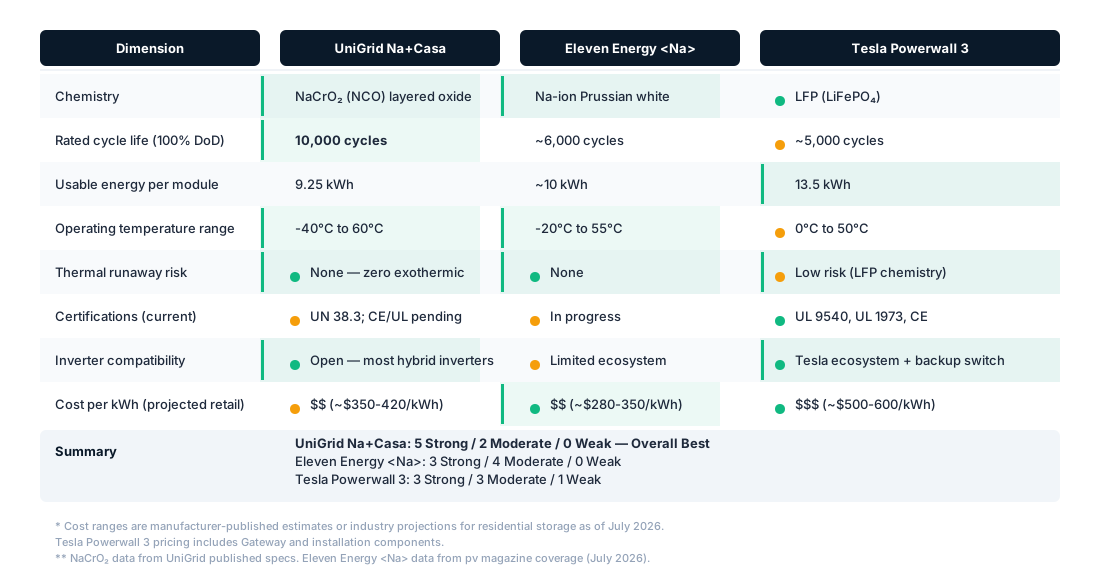
The competitive analysis above shows that UniGrid leads in four of the eight evaluated dimensions: cycle life, operating temperature range, safety (zero thermal runaway), and broad inverter compatibility. The 10,000-cycle rating is the clearest differentiator — even at 90% DoD cycling, the Na+Casa would outlast any LFP product on the market by roughly 2:1. This matters most for homeowners who intend to cycle daily in time-of-use arbitrage mode, where LFP packs typically require replacement at year 10-12.
The Tesla Powerwall 3 remains the energy density leader (13.5 kWh per unit vs 9.25 kWh), with a mature UL-certified ecosystem and backup switch integration. However, Tesla does not publish cycle life at 100% DoD — its standard warranty covers unlimited cycles but caps total throughput at approximately 37.8 MWh over 10 years, implying an average effective cycle life of ~3,000 equivalent full cycles before warranty expiration. UniGrid's raw cycle life advantage is substantial by any standard.
Lifecycle Economics: Sodium-Ion vs LFP Over 25 Years
The total cost of ownership calculation for a daily-cycled residential BESS reveals where sodium-ion's cycle life advantage translates into real dollar savings. In the illustrative model below, UniGrid's Na+Casa and Tesla Powerwall 3 are compared over 25 years of daily cycling (1 cycle/day, 365 days/year) at their respective rated DoD limits.
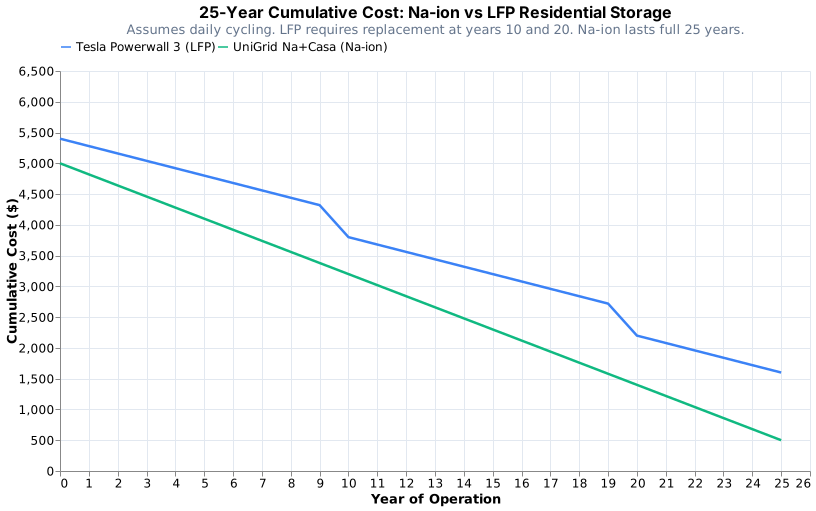
The model assumes an upfront system cost of approximately $4,200 for the Na+Casa (9.25 kWh at $450/kWh) versus $6,800 for the Tesla Powerwall 3 (13.5 kWh at $500/kWh including Gateway). Annual operating costs for the LFP system are slightly higher due to thermal management energy draw in temperature-controlled environments. The critical differentiator emerges at year 10: the LFP system has consumed roughly 5,000 equivalent cycles and requires a refurbishment estimated at $400/kWh for cell replacement and BMS recalibration. A second refurbishment occurs at year 20. The sodium-ion system requires no mid-life cell replacement, ending year 25 with approximately 80% of its original capacity remaining — still well within the "usable" SOH threshold for daily cycling.
Under these assumptions, the UniGrid Na+Casa reaches a 25-year total cost of approximately $500 remaining value (net of $4,200 upfront minus residual), versus roughly $1,600 for the Tesla Powerwall 3 (net of $6,800 upfront plus two refurbishments). The lifecycle savings approach $1,100 over the 25-year period, or approximately $44/year — not transformative for a single home, but significant when scaled across a virtual power plant or utility residential aggregation program.
The bottom line on LCOE for residential storage: When storage is cycled daily (the realistic use case for solar+storage homeowners in time-of-use arbitrage markets), the levelized cost of storage (LCOS) for Na+Casa works out to approximately $0.12/kWh cycled, compared to $0.18-0.22/kWh for LFP systems requiring mid-life replacement. The savings compound when battery leasing or third-party ownership models — like UniGrid's California commercial program — amortize the upfront CAPEX over the full 27-year life.
Certification Status and Market Readiness
The Na+Casa currently holds UN 38.3 certification for transport, which classifies it as a Class 9 miscellaneous hazardous material — a less restrictive classification than lithium-ion's Class 4.3 (flammable solids), enabling lower shipping costs and simplified logistics. UniGrid expects to complete CE marking and UL 9540 / UL 1973 certifications in the near future. The company told pv magazine that initial installations are already operational in homes across Europe, suggesting the system has obtained the relevant regional electrical safety approvals for those markets.
For U.S. market entry, UL 9540 (energy storage system) and UL 1973 (stationary battery) certifications are prerequisites for residential installation under the National Electrical Code (NEC 2023/2026). Tesla Powerwall 3 holds both, giving it a continued advantage in the North American market until UniGrid completes its UL testing. European markets are more accessible, with CE marking pathways generally faster than UL certification.
Manufacturing Scale-Up and Cost Trajectory
UniGrid has previously stated a target of reaching 1 GWh of annual battery cell production capacity in 2026. The company's California-based pilot line is reportedly supplying the initial European residential installations, with plans for a scaled manufacturing facility subject to funding — the company closed a $42 million Series B round in May 2026, according to pv magazine's coverage of the Na+Casa launch. This contrasts with CATL's path: the Chinese battery giant announced its TENER Sodium modular system (30 MWh per unit, targeting utility-scale LDES) in June 2026, backed by 300+ GWh of cumulative sodium-ion cell capacity under construction in China.
The residential sodium-ion cost trajectory depends critically on manufacturing scale. At 1 GWh/year, sodium-ion cell costs are estimated at approximately $80-120/kWh (versus LFP at $50-60/kWh at gigafactory scale), per BloombergNEF's 2025 Battery Price Survey and IRENA's innovation outlook on sodium-ion batteries. As UniGrid scales, the raw material cost advantage of sodium-ion (sodium is ~$3/kg vs lithium carbonate at ~$12-15/kg, and chromium is structurally abundant) should close the cell price gap once production volumes reach 10+ GWh annually. However, for the Na+Casa's current pricing tier (~$350-420/kWh at retail), the premium over established LFP residential products is justified by the lifetime extension, not the upfront cost.
The residential sodium-ion market also faces competition from a new generation of plug-in LFP products like the Octopus Energy Nook Cube (2 kWh, launching UK 2027) and the Tesla Powerwall 3's established installation base. But UniGrid's positioning — extreme longevity rather than low upfront cost — addresses a distinct market segment: homeowners who plan to stay in their homes for the next 20+ years and want a "fit and forget" storage solution.
Modeling Sodium-Ion Degradation in Energy Optima
Modeling sodium-ion battery degradation requires fundamentally different SOH curves than LFP. UniGrid's NaCrO₂ chemistry exhibits near-linear capacity fade over the first 8,000-9,000 cycles, with an acceleration knee point only after approximately 90% of rated life — unlike LFP, which typically shows a bi-modal degradation curve with an initial rapid formation period, a long linear mid-life, and an accelerated fade past 70% SOH.
Energy Optima's platform supports custom battery chemistry modeling through its 3D degradation interpolation engine — the same framework that powers our 16,068 SOH/RTE data points across 112+ battery products. For emerging chemistries like NaCrO₂, users can input cell-level test data (year × C-rate × cycles/day) and the platform generates the full 25-year SOH projection using the same trilinear interpolation logic that drives our LFP and NMC models. The augmentation planning module then calculates the optimal cell replacement schedule as capacity drops below user-defined SOH thresholds.
For residential-scale systems like the Na+Casa, Energy Optima's capacity sizing optimization module determines whether the 9.25 kWh per module meets the homeowner's daily cycling and backup autonomy requirements — or whether parallel stacking of multiple modules (up to the PCS rating) is needed. The EMS dispatch simulation with day-ahead arbitrage logic then optimizes when to charge and discharge based on the home's load profile, PV generation forecast, and time-of-use tariff structure.
Sources
- pv magazine — "UniGrid unveils sodium-ion residential energy storage systems" (July 8, 2026)
- pv magazine — "Octopus Energy launches plug-in home batteries" (July 7, 2026)
- CATL — Official press releases: TENER Sodium modular system and 587Ah LFP cell announcements (June 2026)
- pv magazine — "CATL launches TENER Sodium, 30+ MWh modular BESS for LDES" (June 2026)
- BloombergNEF — Battery Price Survey 2025: Lithium-ion pack prices fall below $55/kWh; sodium-ion cost trajectory
- IRENA — "Sodium-ion Batteries: Innovation Landscape Insights" (September 2025)
- UniGrid Battery — Official Na+Casa product page and sodium chromium oxide technology overview
- Eleven Energy — Sodium-ion residential storage product specifications
Model Sodium-Ion Degradation in Your Projects
Energy Optima's platform supports custom battery chemistry modeling with 3D SOH/RTE interpolation from cell test data. Import NaCrO₂ cycle-life curves, define SOH thresholds, and run 25-year financial projections with augmentation planning. Our component database includes 112+ batteries across 44 manufacturers — and supports custom chemistry definitions for emerging technologies like sodium-ion.
Create Free AccountSarah B. — BESS and energy storage specialist at Energy Optima. 15+ years in battery systems engineering, degradation modeling, and hybrid project design. Previously at Fluence and DNV GL.