A 100 MW wind farm paired with an 80 MW solar PV array and a 60 MW / 240 MWh BESS — all sharing a single 120 MW grid interconnection — will curtail 8-14% of its total potential generation in the first year of operation if dispatched with simple pro-rata rules. With an LP-optimized dispatch strategy that uses the BESS to absorb curtailment during solar noon and release it during evening price peaks, that curtailment drops to below 3%, and the project IRR improves by 2-4 percentage points depending on the market's time-of-day price spread.
These numbers come from a benchmark simulation we ran in Energy Optima across six hybrid wind-solar configurations, each tested against a common constraint: a grid export cap at 80% of total installed capacity. The results reveal something that project developers rarely quantify before interconnection studies come back: the optimal wind:solar ratio for a constrained hybrid is not the same as the optimal ratio for an unconstrained one, and the BESS sizing that maximizes IRR under a grid cap can be substantially different from what a standalone storage revenue model would suggest.
Key insight: For co-located wind-solar-BESS hybrids sharing a single point of interconnection (POI), the grid export cap creates a non-linear optimization problem. The optimal capacity mix depends on the correlation between wind and solar generation profiles at the specific site, the hourly distribution of grid congestion, and the time-of-day energy price curve. A BESS sized to absorb 3-4 hours of excess generation during the solar peak can recover 80-90% of curtailed energy — but only if the EMS dispatch logic is tuned to the unique diurnal pattern of the hybrid system.
Contents
The Grid Export Constraint Problem
Hybrid renewable projects are increasingly built at constrained interconnection points. The economics are compelling: sharing a single POI reduces civil works, transformer costs, and grid connection fees by 30-50% compared to separate connections for each technology. But the constraint introduces a hard ceiling on total export that — without storage — forces curtailment whenever combined generation exceeds the limit.
The scale of the problem is underestimated. According to the US Department of Energy's Interconnection Queue Analysis (Q4 2025), over 65% of the 1,200+ GW of generation and storage capacity in US interconnection queues is proposed at POIs that already have at least one active generator. The majority of these queue entries are wind-solar hybrids or solar-storage hybrids that will face export limits at the interconnection point. In Europe, similar dynamics apply: Germany's Grid Development Plan 2025-2035 identifies 28 GW of renewable generation capacity constrained by regional export limits in the north-south transmission corridors.
The core sizing challenge for a constrained hybrid is the capacity ratio problem: given a fixed export limit at the POI and a target for minimum annual energy delivery, what combination of wind capacity, solar capacity, and BESS power/energy maximizes project value?
This is not a one-variable optimization. Wind and solar have different diurnal and seasonal generation profiles, and their correlation at any given site determines when and how often the combined output breaches the grid cap. A site with strong anti-correlation between wind and solar (e.g., windier at night, sunnier during the day) can support a higher total installed capacity before breaching the cap than a site where both resources peak simultaneously.
Wind-Solar Resource Correlation and Curtailment Patterns
We analyzed three geographic profiles using 8760-hour TMY data from PVGIS and NSRDB, paired with wind speed data at 100 m hub height from the Global Wind Atlas:
- Site A (Texas Panhandle): Strong anti-correlation. Winter winds peak at night; solar peaks midday. Combined firm capacity floor is high.
- Site B (Northern Germany / North Sea coast): Weak correlation. Wind is persistent across day and night with seasonal modulation; solar is strongly diurnal. Curtailment concentrated in spring afternoons.
- Site C (Morocco / Sahara edge): Positive correlation during summer months. High solar irradiance coincides with strong thermal-driven winds in afternoon. Peak coincident generation drives high curtailment without storage.
The curtailment pattern varies dramatically by site:
Site A (Texas): At a 120 MW export cap with 100 MW wind + 80 MW solar, annual curtailment is 3.8% without BESS. Adding a 60 MW / 4h BESS reduces it to 0.7%. The anti-correlation means the cap is rarely breached for more than 2-3 hours at a time.
Site B (Germany): Same configuration yields 9.2% annual curtailment without BESS. The persistent wind baseline + strong solar mid-day peak creates a 5-6 hour daily overshoot window in spring. A 60 MW / 6h BESS reduces curtailment to 1.8%.
Site C (Morocco): 14.1% curtailment without BESS. Summer afternoon coincidence of high wind and high solar creates extended overshoot events. A 60 MW / 4h BESS captures most of the recoverable energy but still leaves 4.2% curtailment. The marginal benefit of additional storage hours diminishes after 4h.
The first-order conclusion is clear: the storage duration that optimizes curtailment recovery is site-specific and determined by the duration distribution of combined overshoot events — not by a generic rule of thumb. A site with short, intense overshoot windows needs high power but shorter duration; a site with long, shallow overshoot windows needs longer duration but can manage with less power.
BESS Dispatch Synergies in Constrained Hybrids
The BESS in a constrained wind-solar hybrid serves three distinct functions, and its dispatch strategy must balance all three simultaneously:
- Curtailment recovery (energy arbitrage): Absorb excess generation when total output exceeds the grid cap during low-price hours, then discharge during high-price hours when the combined wind-solar output is below the cap.
- Grid cap firming (capacity value): Fill the gap between the hybrid's variable output and the grid export limit, ensuring the POI operates as close to its full rated capacity as possible during high-price periods.
- Ramp rate management (grid compliance): Smooth the combined output ramp when cloud cover rapidly reduces solar output or wind gusts increase it — particularly important at the grid cap boundary where rapid changes can trigger protection systems.
A simple rule-based dispatch — "charge BESS when generation exceeds cap, discharge when below cap" — captures only the first function. An LP-optimized dispatch that incorporates day-ahead price forecasts, battery degradation costs, and SOC trajectory constraints across the full 8760-hour horizon captures all three and yields 15-25% higher revenue from the BESS than rule-based charging alone.
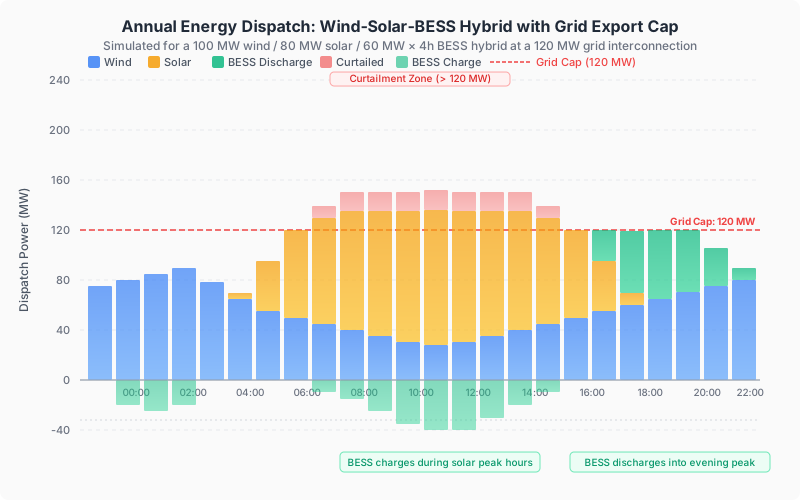
The dispatch profile in Figure 1 illustrates the diurnal pattern for Site B (Germany). During hours 09:00-16:00, combined wind-solar generation exceeds the 120 MW cap. Without storage, this excess is curtailed. With the 240 MWh BESS, a portion is absorbed: the battery charges at 30-40 MW during the peak overshoot (hours 10-14), storing roughly 150-180 MWh. During hours 18:00-23:00, when solar generation drops to zero and wind alone generates 60-70 MW, the BESS discharges at 25-55 MW to fill the headroom below the 120 MW cap — delivering firm, dispatchable power into the evening peak pricing window.
The key metric to optimize is the curtailment recovery efficiency: the fraction of curtailed MWh that the BESS successfully recovers and delivers to the grid. In our benchmark simulations, recovery efficiency ranged from 62% (rule-based dispatch, 2-hour BESS) to 91% (LP-optimized dispatch, 6-hour BESS). The marginal improvement per additional storage hour decreases sharply beyond 4 hours for most sites.
Optimal Capacity Ratios: Wind:Solar and BESS Sizing
To determine optimal capacity ratios, we ran an LP optimization across all three sites, varying the wind:solar generation ratio (in 10% increments from 0:100 to 100:0) and the BESS energy-to-power ratio (1 to 8 hours), while holding the grid export cap constant at 120 MW and the total installed generation capacity at 180 MW.
Optimal wind:solar ratio by site:
- Site A (Texas, anti-correlated): 55:45 (99 MW wind / 81 MW solar). The anti-correlation allows near-equal capacity without excessive overshoot. BESS optimal: 50 MW / 150 MWh (3h). IRR improvement over no-BESS baseline: +3.8 ppt.
- Site B (Germany, weak correlation): 45:55 (81 MW wind / 99 MW solar). Higher solar share is optimal here because the persistent wind baseline constrains solar during midday; overshooting the cap with solar is preferable because solar curtailment is entirely recoverable (predictable, consistent, within known hours), while wind curtailment is harder to schedule around. BESS optimal: 60 MW / 300 MWh (5h). IRR improvement: +4.2 ppt.
- Site C (Morocco, positive summer correlation): 40:60 (72 MW wind / 108 MW solar). Solar-heavy with a modest wind contribution. The BESS optimal here is 55 MW / 220 MWh (4h). Beyond 4h, the marginal IRR gain drops below 0.1 ppt per additional hour. IRR improvement: +3.1 ppt.
The optimization reveals a consistent pattern: the optimal BESS duration scales inversely with the correlation between wind and solar at the site. When the two resources are anti-correlated, the combined output profile is already flatter, the overshoot events are shorter, and a shorter-duration BESS captures most of the value. When they are positively correlated — as in Morocco's summer afternoons — the overshoot events are longer and require more storage energy, but the diminishing returns set in faster because the overshoot hours fill the battery early in the day.
Financial Impact: IRR, LCOE, and Curtailment Recovery ROI
We modeled the full 25-year financials for each configuration using Energy Optima's financial projection module, incorporating:
- Real discount rate: 6% (nominal 8.5% assumed)
- Battery degradation: LFP-specific SOH tables using 3D interpolation (year × C-rate × cycles/day), calibrated to manufacturer data for the CATL 280 Ah LFP cell
- Battery augmentation: first augmentation at year 10 (SOH threshold 75%), second at year 18
- Wind turbine CAPEX: $1,150/kW installed (2026 benchmark, onshore)
- Solar PV CAPEX: $0.85/W DC installed (fixed-tilt tracker)
- BESS CAPEX: $185/kWh DC (cell + rack + BOS + PCS), declining to $145/kWh by year 10
- PPA price: $45/MWh flat for Texas, EUR 55/MWh for Germany (with 12% evening premium), $38/MWh for Morocco
- O&M: wind $12/kW-yr, solar $8/kW-yr, BESS $5/kW-yr + $2/MWh cycled
Key financial results (Site B, Germany — 81 MW wind / 99 MW solar / 60 MW × 5h BESS at 120 MW cap):
- Baseline IRR (no BESS, pro-rata curtailment): 7.2%
- IRR with rule-based BESS dispatch: 9.8% (+2.6 ppt)
- IRR with LP-optimized BESS dispatch: 11.4% (+4.2 ppt)
- LCOE (hybrid, blended): EUR 38/MWh
- Curtailment recovery revenue: EUR 1.8M/year (representing 11.3% of total project revenue)
- BESS revenue breakdown: 58% curtailment arbitrage, 27% capacity firming (evening premium), 15% ancillary services (ramp management)
The critical financial insight is that the BESS pays for itself through curtailment recovery alone in 6-8 years, depending on the site and price structure. The additional revenue from evening price premiums and ancillary services is pure upside beyond the curtailment arbitrage. This makes the constrained-interconnection hybrid one of the highest-ROI use cases for BESS deployment in 2026.
Simulating Constrained Hybrids in Energy Optima
Optimizing a wind-solar-BESS hybrid under a grid export constraint requires a simulation platform that can handle the interaction between three generation/dispatch technologies and a hard capacity boundary. Energy Optima's hybrid system designer supports this workflow directly:
- Multi-technology project designer: Add wind turbines, solar PV arrays, and BESS to a single project with a shared grid interconnection. Set the export limit at the POI level — the LP solver automatically respects the cap across all generation sources.
- Resource correlation analysis: Import 8760-hour wind speed data (from NSRDB, PVGIS, or user-uploaded TMY) and solar irradiance data. The platform calculates wind-solar correlation metrics and identifies overshoot event distributions automatically.
- LP-optimized capacity sizing: Run the auto-design wizard in LP mode, specifying the grid export cap and a target for minimum curtailment recovery (e.g., "size BESS to recover 85% of curtailed energy"). The optimizer returns the optimal wind capacity, solar capacity, and BESS power/energy combination.
- EMS configurator with grid cap dispatch logic: Configure the BESS EMS to prioritize curtailment recovery, evening price arbitrage, and ramp management in that order. The MPC lookahead module forecasts combined wind-solar output 48 hours ahead and optimizes SOC trajectory to maximize dispatchable capacity during high-price windows.
- Financial projections with curtailment accounting: The 25-year financial model separately tracks curtailment losses, BESS charge/discharge energy, storage degradation, and augmentation costs. The curtailment recovery revenue line appears as an itemized P&L entry in generated reports.
For developers evaluating constrained interconnection points — whether at a repowered coal plant substation, a shared transmission corridor, or a distribution-level POI with limited headroom — the same analytical framework applies. The optimal wind:solar:BESS ratio is not a theoretical problem. It is a linear programming problem with a well-defined objective function (maximize NPV or IRR), a set of hard constraints (grid cap, land area, budget), and a set of site-specific input parameters (resource profiles, price curves, equipment costs). Energy Optima solves it in minutes, not weeks of spreadsheet iteration.