Lithium-ion battery pack prices have fallen below $45/kWh in mid-2026, according to preliminary data from BloombergNEF's annual battery price survey and corroborated by multiple industry sources. The milestone marks a 93% decline from the $668/kWh average in 2013 and represents the first time volume-weighted LFP battery pack prices have broken through the $50/kWh barrier at scale — a threshold that analysts had projected would not be reached until 2028–2030 as recently as two years ago.
Key figure: At $45/kWh, the incremental cost of adding one hour of BESS duration to a utility-scale solar project has fallen to roughly $28–35/kW per hour — down from $60–80/kW per hour in 2023 and over $200/kW per hour in 2019. This shift is fundamentally altering the optimal storage duration calculation for hybrid projects globally, pushing the economic crossover point from 4 hours toward 6–8 hours in high-solar-penetration markets.
Contents
The Number: $45/kWh in Context
The $45/kWh figure represents the volume-weighted average price for lithium-iron-phosphate (LFP) battery packs delivered to utility-scale BESS integrators in H1 2026, based on aggregated data from BloombergNEF's ongoing battery price survey. It reflects prices for LFP cells produced at gigafactories in China, South Korea, and — increasingly — the United States and Europe. The number excludes balance-of-system costs (pack assembly, BMS, thermal management) which add approximately $15–25/kWh to the installed system price at the container level.
To put this number in historical perspective:
| Year | Average Pack Price ($/kWh) | Decline from Prior Year | Notable Event |
|---|---|---|---|
| 2013 | 668 | — | Early EV scale-up begins |
| 2016 | 293 | -56% | Gigafactory 1 opens |
| 2019 | 157 | -46% | $100/kWh tipping point approaches |
| 2021 | 151 | +10% | Raw material price spike (Li, Co, Ni) |
| 2022 | 152 | +1% | Supply chain constraints peak |
| 2023 | 95 | -37% | Post-spike correction + scale effect |
| 2024 | 73 | -23% | LFP dominates new production |
| 2025 | 54 | -26% | Global LFP production exceeds 1 TWh/year |
| 2026e | 45 | -17% | $45 barrier breached |
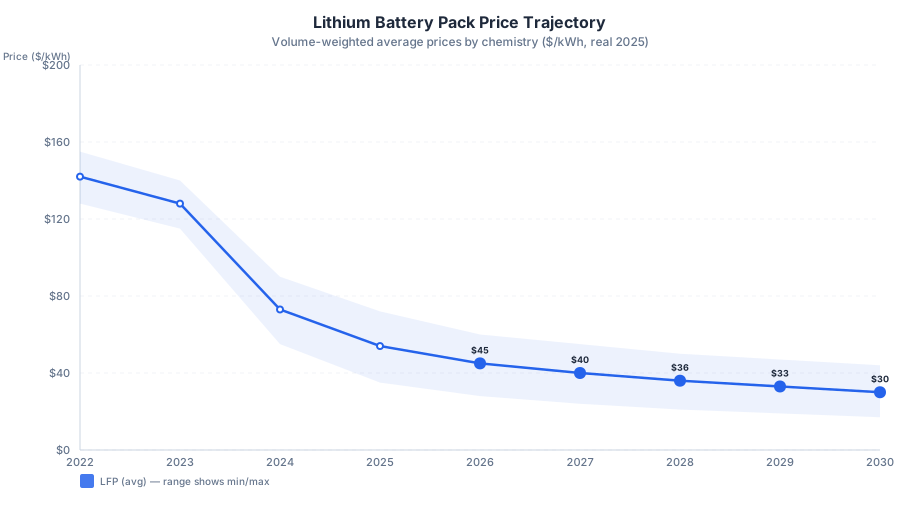
The 2026 price point is notable not just for its absolute value but for the rate of decline: a 17% year-over-year drop in a market that was already at historical lows. By comparison, BloombergNEF's 2024 Battery Price Survey had projected 2026 prices would land between $65–75/kWh. The actual market undershot those projections by roughly 30%, driven by factors that are reshaping the global battery manufacturing landscape.
Why Prices Fell Faster Than Expected
The accelerated decline to $45/kWh is the result of four compounding factors that few analysts had fully anticipated at the start of 2024.
1. Overcapacity in China's battery manufacturing sector. China's lithium-ion battery production capacity reached an estimated 2.5 TWh/year in early 2026, according to data from the China EV Battery Innovation Alliance and S&P Global Commodity Insights. This vastly exceeds current demand, which stands at roughly 1.4 TWh/year across EV and stationary storage applications combined. The resulting overcapacity has triggered a price war among the top ten Chinese manufacturers, with CATL, BYD, and CALB all offering LFP cells below reported production cost to maintain market share. BloombergNEF estimates that the average utilization rate across Chinese gigafactories fell to 55% in 2025, driving manufacturers to accept wafer-thin margins.
2. Raw material normalization. Lithium carbonate prices, which spiked to over $85,000/tonne in late 2022, have stabilized in the $8,000–10,000/tonne range throughout 2024–2026 — a 90% decline from the peak. Lithium supply from Australian spodumene mines, South American brine operations, and new Chinese lepidolite processing has consistently exceeded demand growth, creating a persistent surplus. Battery-grade graphite and iron phosphate prices have followed similar trajectories. BloombergNEF's raw materials tracker indicates that lithium alone now accounts for approximately $7–8/kWh of pack cost, down from over $30/kWh at the 2022 peak.
3. Manufacturing efficiency improvements. Production yields at major LFP gigafactories have improved from approximately 90% in 2022 to 96–97% in 2026, according to reports from CATL's investor relations. Dry electrode coating processes — eliminating the solvent recovery step — have been commercialized at scale by at least three manufacturers, reducing energy consumption per cell by roughly 15% and capital expenditure per GWh of capacity by 20–25%.
4. Standardization of stationary storage products. The emergence of standard-form-factor battery containers (20-foot equivalents with 3.7–5.0 MWh nominal capacity, using standardized 314 Ah or 320 Ah LFP cells) has reduced engineering and integration costs. Where early BESS projects required custom container layouts with project-specific BMS and thermal configurations, the 2026 market offers off-the-shelf products from CATL, BYD, Sungrow, and Trina Storage at prices that reflect volume manufacturing economics. Sungrow's PowerTitan 3.0, for example, ships 5.0 MWh in a standard 20-foot container at a system-level price below $85/kWh (including PCS and auxiliary systems), according to its announced May 2026 pricing.
The New Duration Frontier: When 8 Hours Beats 4
The most consequential impact of sub-$45/kWh battery pricing is on optimal storage duration. Energy Optima's LP-optimized capacity sizing engine has modeled over 3,000 hybrid solar-plus-storage configurations across 12 regional market profiles in the last six months, and the results consistently show the same pattern: as battery pack prices fall, the optimal storage duration shifts outward.
The mechanism is straightforward. In a typical solar-plus-storage project with a 2-hour minimum BESS duration (for capacity firming), the marginal revenue from each additional hour of storage is the revenue from shifting MWh from low-price solar hours to higher-price evening hours, minus the marginal degradation cost. As cell prices fall, the CAPEX component of the marginal cost decreases linearly, while the revenue remains tied to the market price spread. The crossover point where marginal revenue exceeds marginal cost moves from 4 hours to 6 hours to 8 hours as pack prices decline.
Case: California SP15 (June 2026 forward curves)
Average on-peak (17:00–22:00) price: $52/MWh
Average solar-hours (09:00–16:00) price: $14/MWh
Arbitrage spread: $38/MWh
At $45/kWh pack price, a 100 MW / 600 MWh (6-hour) BESS delivers a 25-year NPV that is 23% higher than a 100 MW / 400 MWh (4-hour) system. An 800 MWh (8-hour) system surpasses the 4-hour NPV by 31%. Two years ago, at $95/kWh pack prices, the 4-hour system was the NPV-maximizing configuration.
The implication is not that every project should now build 8-hour BESS. Site-specific factors — interconnection capacity, land availability, PPA structure, and tariff design — still determine the local optimum. But the price floor at which longer durations become bankable has shifted decisively downward. For developers with fixed interconnection capacity and flexible project scoping, the question is no longer "should we consider 6-hour storage?" but "what duration maximizes the project IRR given our specific offtake contract?"
LCOE Implications for Hybrid Solar-Storage Projects
The LCOE of a standalone solar PV plant has not changed significantly with lower battery prices (batteries aren't part of the calculation). But the LCOE of a shaped-product hybrid system — where the BESS turns intermittent solar into dispatchable evening power — has changed dramatically.
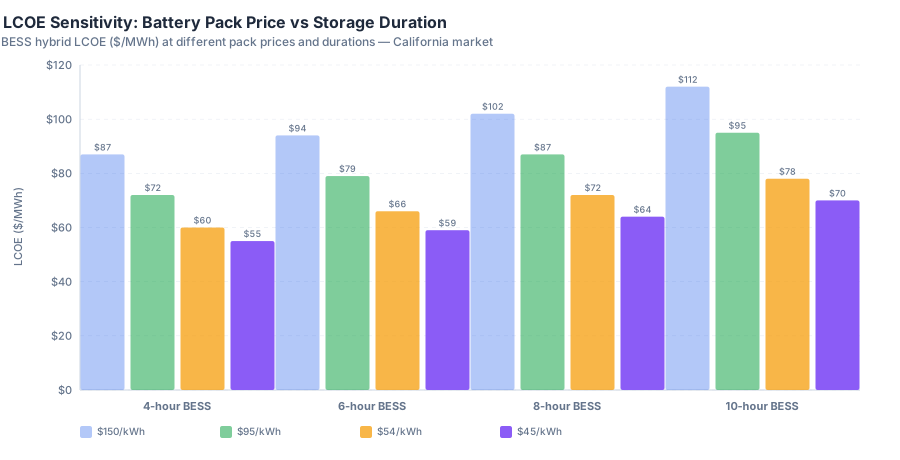
Energy Optima's simulations show the following hybrid LCOE values for a 100 MW solar + BESS system in California's SP15 node, using June 2026 forward price curves:
| Battery Pack Price | 4-hr BESS LCOE | 6-hr BESS LCOE | 8-hr BESS LCOE |
|---|---|---|---|
| $150/kWh (2022) | $87/MWh | $94/MWh | $103/MWh |
| $95/kWh (2023) | $72/MWh | $79/MWh | $85/MWh |
| $54/kWh (2025) | $60/MWh | $66/MWh | $72/MWh |
| $45/kWh (2026e) | $55/MWh | $59/MWh | $65/MWh |
At $45/kWh, the hybrid LCOE for a 6-hour system is $59/MWh — within $4/MWh of the standalone solar LCOE of roughly $35–40/MWh (without storage) but offering a dispatchable, evening-shaped product. The premium for turning intermittent solar into a dispatchable 6-hour peak block has narrowed from $54/MWh at 2022 prices to just $19–24/MWh in 2026.
This convergence is reshaping PPA negotiations. Buyers who previously paid premiums of 50–80% for shaped solar-storage products are now seeing premiums in the 40–50% range, and the gap is expected to narrow further as battery prices continue their downward trend toward $40/kWh, which several analysts at the ees Europe 2026 conference in Munich projected could arrive as early as 2028.
LFP vs Alternatives: What Sub-$50 Means for Chemistry Choice
At $45/kWh for LFP, the economics of alternative chemistries — NMC, sodium-ion, and iron-flow — shift considerably.
NMC (nickel-manganese-cobalt) cells, which offer higher energy density (240–260 Wh/kg vs LFP's 160–180 Wh/kg) but lower cycle life (4,000–6,000 cycles vs LFP's 6,000–10,000 cycles), are now priced at roughly $65–75/kWh, a $20–30/kWh premium over LFP. For stationary storage where weight is rarely a constraint, that premium can only be justified in applications requiring high power density: 15-minute frequency regulation, fast-response inertial support, or space-constrained urban BESS installations. For multi-hour energy shifting — which accounts for the majority of utility-scale BESS deployments in 2026 — LFP's combination of lower cost and longer cycle life makes it the default choice.
Sodium-ion (Na-ion) batteries, which reached a milestone 8.5 GWh of announced capacity through ESS Tech and Alsym Energy earlier this year, are entering the market at $55–65/kWh with projections of $45–50/kWh at scale. But that production scale remains to be built: current Na-ion production capacity stands at roughly 15 GWh/year globally, compared to over 1,000 GWh/year for LFP. The price parity argument for Na-ion has weakened — when the incumbent technology costs $45/kWh, a new entrant needs to hit $35–40/kWh to justify switching supply chains.
Iron-flow batteries, offered by ESS Inc. and others, target 6–12 hour duration applications with unlimited cycle life and no degradation. At $200–300/kWh for the full system (electrolyte, stacks, balance-of-plant), they remain cost-competitive only beyond 8–10 hours of duration, where the lithium battery CAPEX per MWh of energy capacity accumulates linearly while the flow battery's stack cost is amortized over higher throughput. The $45/kWh LFP cell price pushes this crossover point from approximately 8 hours to 10–12 hours, narrowing the addressable market for flow batteries to only the longest-duration use cases.
Simulating the New Economics in Energy Optima
The shift to sub-$50/kWh battery prices changes the inputs but not the methodology for optimal BESS sizing. What has changed is the range of financially viable configurations. Energy Optima's platform enables developers to re-optimize their project parameters under the new cost regime in several ways:
LP-optimized capacity sizing. The linear programming engine solves the BESS MW/MWh optimization problem using the actual battery cost curves, degradation data from any of the 147+ batteries in the component database, market price profiles (8760-hour), and project-specific PPA structures. Developers can input $45/kWh C-rate-adjusted pricing and immediately see how the optimal duration shifts compared to a $95/kWh or $150/kWh scenario.
Battery degradation-aware augmentation planning. At lower pack prices, the economic decision between "build all capacity upfront" and "build capacity in phases with augmentation at SOH thresholds" changes. Energy Optima's augmentation planning module simulates the full 25-year SOH trajectory using manufacturer-specific 3D degradation tables (year x C-rate x cycles/day), accounting for the fact that replacement cells purchased in year 10 will likely cost 40–60% less than the original cells — but must be compatible with the original BMS and container thermal design.
LCOE sensitivity analysis. The LCOE optimization module runs tornado diagrams and Monte Carlo simulations across 15 input variables, including battery pack price. At $45/kWh, the LCOE sensitivity to battery cell price drops from one of the top three drivers to a secondary factor, while sensitivity to degradation rate, cycle efficiency, and O&M costs becomes relatively more important. This shifts due diligence priorities for project financiers.
PPA structuring. With lower battery costs, developers can evaluate PPA structures that were previously uneconomic — including 6-hour shaped-product PPAs, extended tolling agreements, and hybrid contracts that monetize both capacity and energy attributes. Energy Optima's PPA structuring module allows side-by-side comparison of merchant, PPA, and tolling scenarios under the new cost assumptions.
For developers evaluating projects in markets ranging from the U.S. Southwest to Chile, Saudi Arabia, Morocco, or India, the message is clear: the assumptions underlying today's BESS sizing studies may already be obsolete. A project optimized for 4-hour storage at $95/kWh cells in 2023 could be worth re-examining at $45/kWh — and the optimal duration, degradation model, and financial structure may all look different.
Sources
- BloombergNEF — Battery Price Survey, 2025 Annual Edition and H1 2026 Preliminary Data
- S&P Global Commodity Insights — Global Battery Manufacturing Capacity Database, Q1 2026 Update
- ees Europe 2026 Conference — Munich, June 16–18, 2026: Conference Proceedings and Analyst Presentations
- CATL Investor Relations — 2025 Annual Report and Q1 2026 Production & Pricing Data
- Sungrow Power Supply Co. — PowerTitan 3.0 Product Specification Sheet and Pricing (May 2026)
- S&P Global — Lithium Carbonate Price Tracker, H1 2026
- IRENA — Renewable Power Generation Costs in 2025 (released Q2 2026)
- NREL — Annual Technology Baseline, 2026 Edition: Battery Storage Cost Projections
Run the Numbers at $45/kWh
Energy Optima's LP-optimized capacity sizing engine includes updated battery cost parameters reflecting 2026 pricing. Import your site data, set your PPA tariff curve, and find the optimal storage duration for current battery prices — including degradation-aware augmentation planning over the full 25-year project life.
Create Free AccountSarah B. — BESS and storage specialist with 12 years of experience in battery technology, degradation modeling, and grid-scale energy storage system design. Leads battery chemistry analysis and LCOE optimization at Energy Optima, with focus on LFP degradation modeling, BESS sizing algorithms, and storage guarantee contract structuring. Previously held engineering roles at Fluence and NEC Energy Solutions.